Personal matters
Counselling in English for individuals and couples
A lot of people who come to me already know where it all comes from. Why they say yes when they mean no, why they end up carrying everything, or why they keep choosing the same kind of person. And it keeps happening anyway, because understanding alone doesn’t change much (if it did, one more article about boundaries would have sorted us all out by now).
In our sessions we look at what your nervous system does in those moments and which inner parts start arguing with each other. The part that wants everyone to be okay, for example, and the part that is simply tired.
That turns into concrete steps for everyday life.
Reasons
What brings people to me
Everyone’s reasons are different, but some sentences come up again and again.
- “I moved here for my partner’s job, and somewhere along the way I lost myself”
- “On paper everything’s fine. So why do I feel so flat?”
- “I say yes to everything and then quietly resent it”
- “Three years in Vienna and I still don’t really feel at home”
- “Every call home leaves me feeling guilty”
- “I can’t switch off, not even on holiday”
- “I keep ending up with the same kind of partner”
- “We have the same argument, just in a different country”
What gets in the way today once had a job to do. If you learned early on to be the easy one, to adapt quickly or to keep things running while everything around you changed, that made sense at the time (and people who grew up moving around often learned exactly that).
Today your body still reaches for the same strategies, even where you could afford to let go. That can change once you understand how it works.
On your own
50 minutes · online or in Bad Fischau-Brunn · EUR 150 (incl. VAT)
Individual counselling
Individual counselling is about you and what happens inside you when a familiar situation comes up. We work with the patterns that are still running and with how you deal with them.
Some people come with a clear question, others just notice that something is off. Either is enough to start. What you do with it is your decision, and my job is to take you somewhere you can see more clearly what’s going on.
Together
90 minutes · online or in Bad Fischau-Brunn · EUR 180 (incl. VAT)
Couples counselling
In couples counselling we work on what keeps happening between you: which patterns repeat, what sets them off and what goes on in each of you before the first word is said.
You’re both in the room, and you both get a say. The question of who’s to blame stays at the door, because it hasn’t helped a single couple yet (and it’s usually been discussed at length at home).
For couples from different countries, sessions can be in English, German or Russian, or a mix of all three if that’s what you speak at home anyway.
Couples counselling makes sense if each of you is willing to take responsibility for your part in the situation. That’s when things can start to shift.
How I work
How a session works
We start with whatever is there right now. When a topic comes up, your body reacts to it, usually faster than your head, and that reaction shows us where to go and how fast.
Then we name what’s happening: which pattern kicked in, when it started and what it was once good for. I’ll tell you what I see, even when it’s uncomfortable to hear (which, as it turns out, is usually why people come back).
Methods
I draw on Compassionate Inquiry by Gabor Maté, parts work based on the Internal Family Systems model (IFS), NLP, and what polyvagal theory describes about the states of the nervous system. With couples, I add elements of Terry Real’s Relational Life Therapy.
Inner parts are the sides of you that everyone recognises: the inner critic, the one who has to get everything right, the one who looks after everyone else. We look at what each of them is trying to achieve.
Setting and location
The work happens within the framework of psychological counselling. If psychotherapy or a doctor is the better place for what you bring, I’ll tell you and help you work out where to go.
Sessions take place online via Zoom or at my practice in Bad Fischau-Brunn, south of Vienna near Wiener Neustadt. Most sessions are online these days, which also means it doesn’t matter where in Austria, Germany or Switzerland you live.
About me
Who you’ll be working with
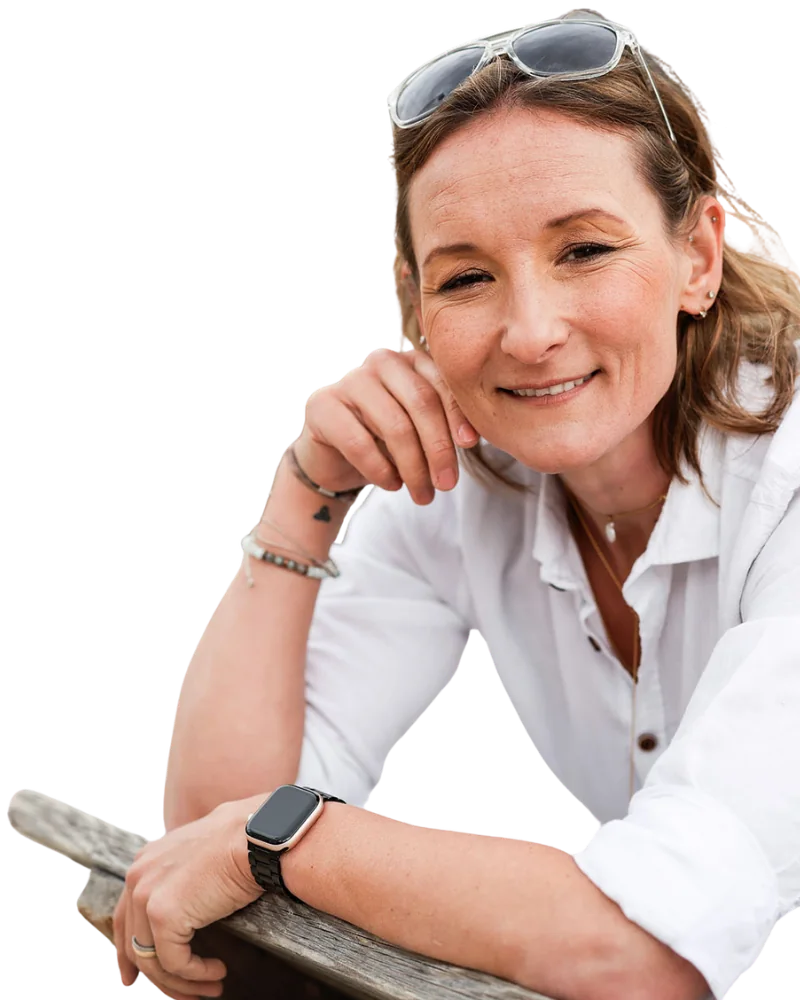
I’m Elena Scherschneva, a state-certified psychological counsellor (Lebens- und Sozialberaterin) and a supervisor listed with the Austrian Economic Chamber (WKO).
I was born in Moscow into a Russian-Ukrainian family, came to Austria as a child and have spent my working life in international settings. Moving between languages and cultures has been part of my everyday life for as long as I can remember, and English, German and Russian are all working languages for me. There’s more about my training on my about page (in German).
The first step
The initial conversation
Before we start working together, we have a short initial conversation. We clarify what it’s about for you, which format fits and whether my way of working suits you.
If it fits, we book a session. If not, I’ll tell you and, as far as I can judge, point you to someone who’s a better fit.
You’re welcome to write to me in English, German or Russian.
Frequently asked questions
Good to know
What happens to what I tell you?
What’s said in the room stays in the room. I’m bound by professional confidentiality, and any notes I make stay with me and aren’t shared with anyone.
Is this therapy?
In Austria, “psychologist” and “psychotherapist” are protected titles, each with its own training. I work as a psychological counsellor within the profession of Lebens- und Sozialberatung, which has its own state qualification and its own scope. We work on what gets in the way of everyday life and relationships, without diagnoses or treatment. If what you bring calls for psychotherapy or a doctor, I’ll say so directly and help you find the right place.
Does insurance cover it?
Public health insurance in Austria doesn’t cover counselling sessions, so you pay for them yourself. If you have private or international health insurance, it’s worth checking your policy. Invoices are available in English.
How many sessions will I need?
That depends on what you bring. Some people are done after two or three sessions, others spend months on something that took years to build. After each session you decide whether and when you’d like to come back.
Can I come on my own if it’s about my relationship?
Yes. Some things are easier to look at together, but a lot works on your own too, because your part in a recurring pattern doesn’t disappear just because your partner isn’t in the room.
Do I need to speak German?
Not at all. Sessions run in English, and if German or Russian is easier for one of you, we can switch or mix as we go.